 Add to Chrome
 Add to Firefox
 Add to Edge
Long-term Power Grid Planning via Answer Set Programming
May 19, 2026
The Power grid is a critical infrastructure underpinning all aspects of modern society and its services. Maintaining its effectiveness requires continuous adaptations. In particular, addressing sustainability targets, demand patterns, and urbanisation trends requires implementing changes to the network. Actual developments can potentially span over a decade, with supply continuity and service quality that must be preserved throughout by ensuring conformance to several topological and combinatorial invariants. Long-term power grid planning deals with the above process, and although planning languages could be a natural choice, the kind of properties and invariants needed are cumbersome to express in such languages; on the contrary, they can be elegantly and succinctly encoded in Answer Set Programming (ASP). In this paper, we propose the first approach to automate and optimise the long-term power grid planning process using ASP. Experimental evaluations conducted on synthetic and real-world grid data confirm the expressive power of the proposed ASP-based approach and demonstrate its effectiveness.

Evaluation of Regularization-based Continual Learning Approaches: Application to HAR
Apr 26, 2023Pervasive computing allows the provision of services in many important areas, including the relevant and dynamic field of health and well-being. In this domain, Human Activity Recognition (HAR) has gained a lot of attention in recent years. Current solutions rely on Machine Learning (ML) models and achieve impressive results. However, the evolution of these models remains difficult, as long as a complete retraining is not performed. To overcome this problem, the concept of Continual Learning is very promising today and, more particularly, the techniques based on regularization. These techniques are particularly interesting for their simplicity and their low cost. Initial studies have been conducted and have shown promising outcomes. However, they remain very specific and difficult to compare. In this paper, we provide a comprehensive comparison of three regularization-based methods that we adapted to the HAR domain, highlighting their strengths and limitations. Our experiments were conducted on the UCI HAR dataset and the results showed that no single technique outperformed all others in all scenarios considered.
Mining useful Macro-actions in Planning
Oct 22, 2018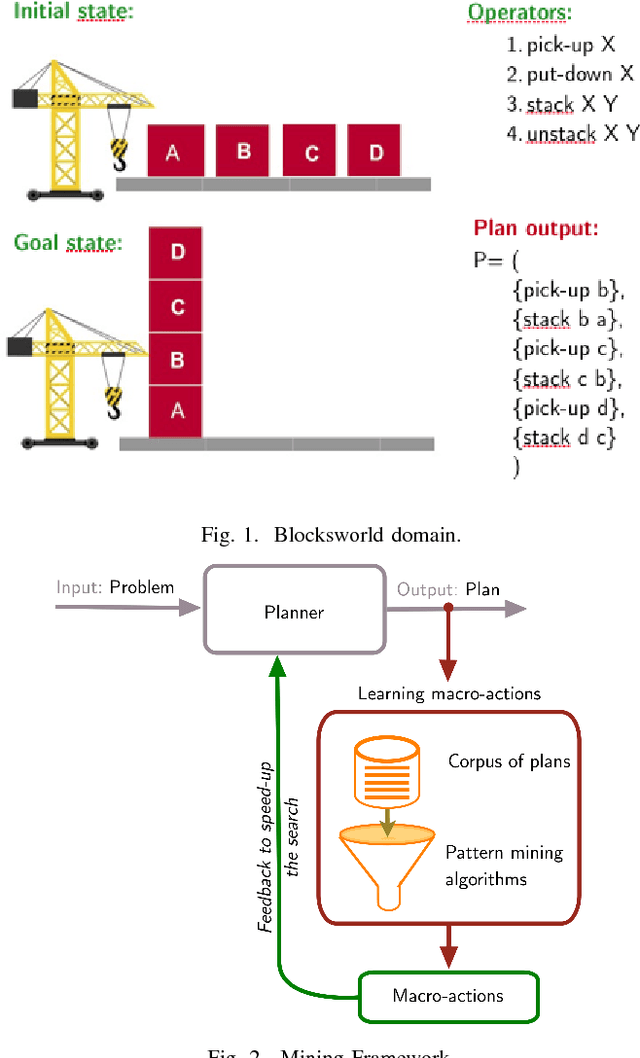
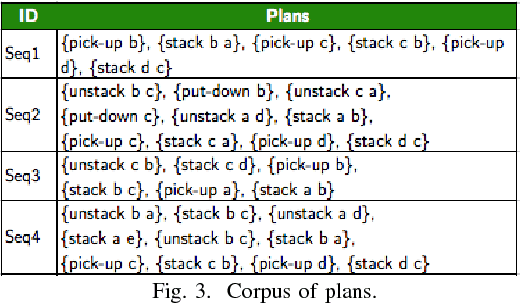
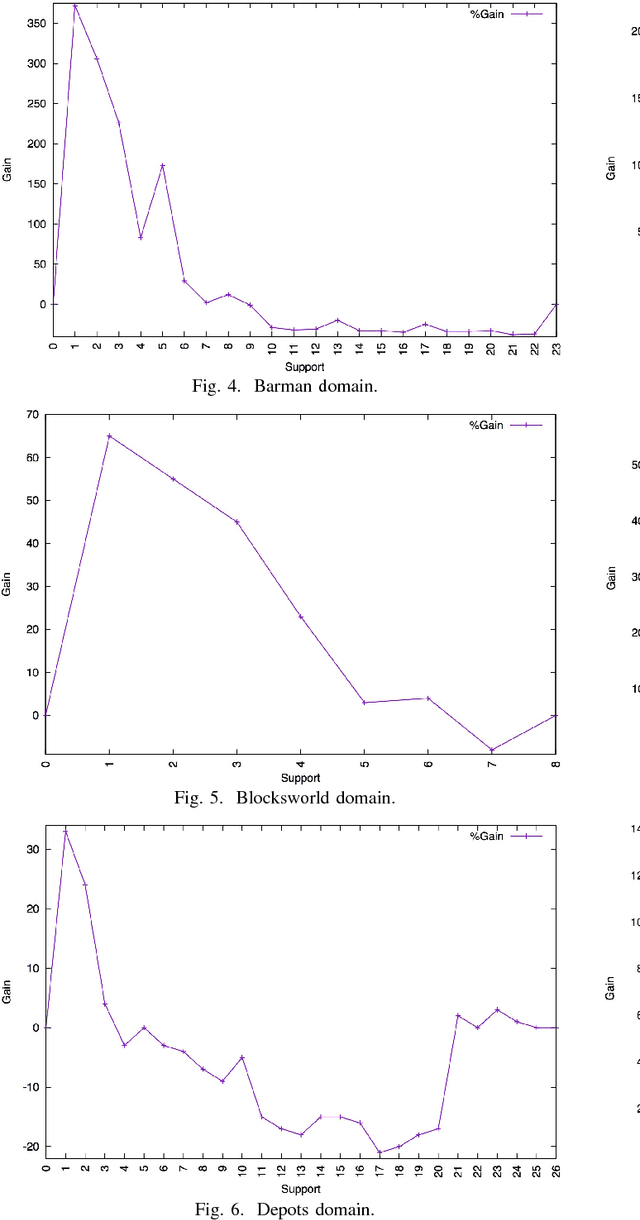
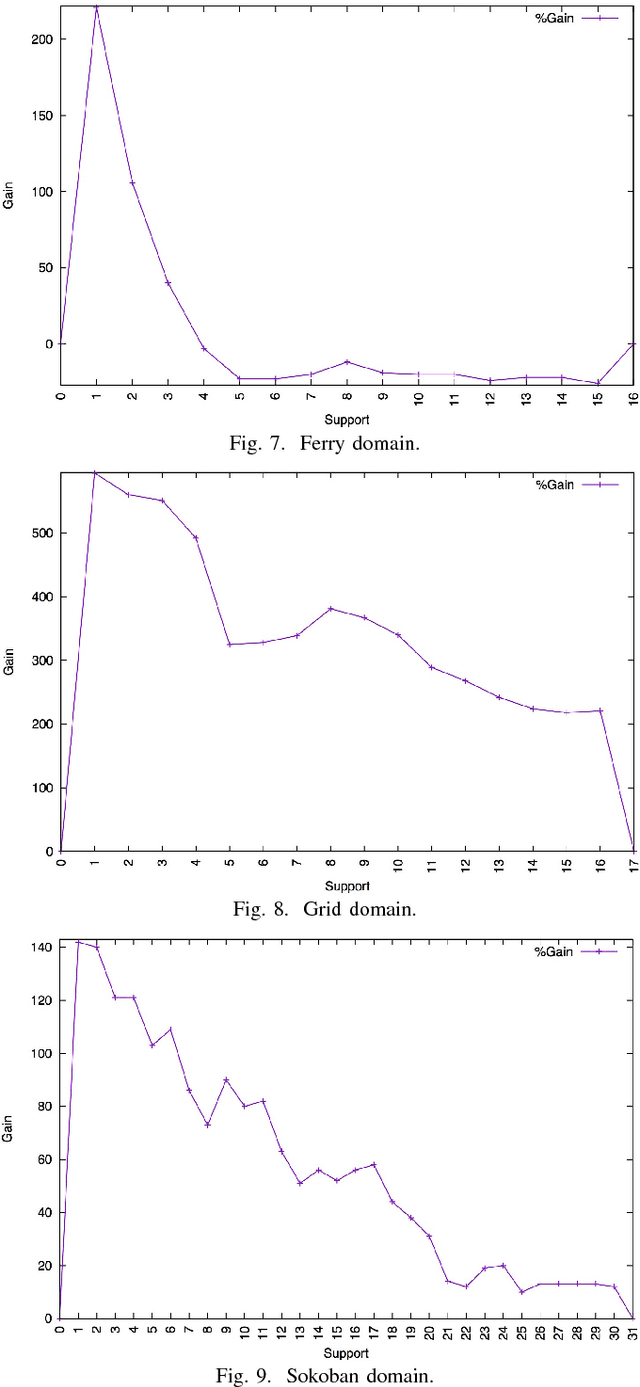
Planning has achieved significant progress in recent years. Among the various approaches to scale up plan synthesis, the use of macro-actions has been widely explored. As a first stage towards the development of a solution to learn on-line macro-actions, we propose an algorithm to identify useful macro-actions based on data mining techniques. The integration in the planning search of these learned macro-actions shows significant improvements over six classical planning benchmarks.
* International Conference on Artificial Intelligence and Pattern Recognition, 2016
Learning Macro-actions for State-Space Planning
Oct 07, 2016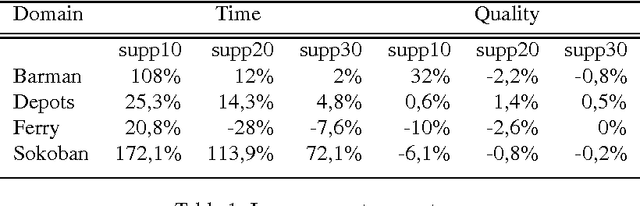
Planning has achieved significant progress in recent years. Among the various approaches to scale up plan synthesis, the use of macro-actions has been widely explored. As a first stage towards the development of a solution to learn on-line macro-actions, we propose an algorithm to identify useful macro-actions based on data mining techniques. The integration in the planning search of these learned macro-actions shows significant improvements over four classical planning benchmarks.